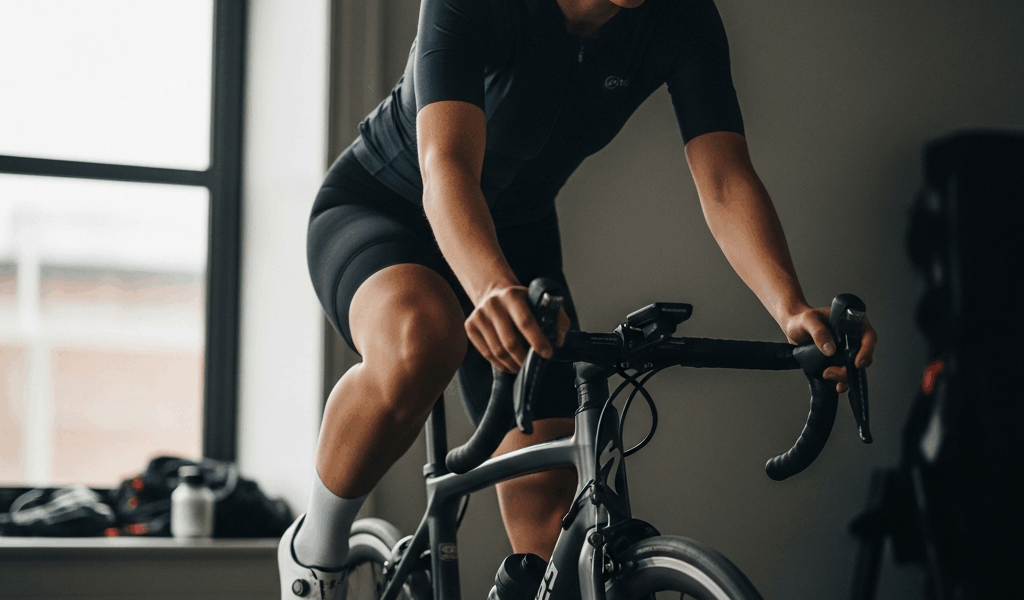
Single Leg Drills on the Bike — Do They Actually Improve Your Pedal Stroke?
Single leg drills have gotten messy with all the conflicting advice flying around. Your coach swears by them. That guy at your local club does them every Tuesday. And you’ve probably spent at least one miserable trainer session clipped in on one side, other leg dangling like a broken kickstand, wondering if any of this is real. I’ve been there — three winters on a Tacx Flux S, grinding through one-legged intervals, genuinely convinced I was smoothing out my dead spot. Then I got a power analysis back from a bike fit. Left-right symmetry? Basically unchanged. That kicked off a deep dive into the actual research, and what I found complicated the whole coaching narrative pretty significantly.
What Single Leg Drills Are Supposed to Do
But what are single leg drills, really? In essence, they’re isolation exercises for your pedal stroke — strip away the second leg, expose every inefficiency. But it’s much more than that, at least in theory.
This article includes affiliate links. We may earn a commission at no extra cost to you.
The standard argument goes like this: when both legs are working, your stronger side covers for the weaker one. Right quad fires hard through the power phase, and whatever the left leg fails to contribute just gets absorbed. The dead spot — that 12-to-3-o’clock transition zone — goes completely undetected because the opposite leg is already driving momentum through its own power phase.
Pull one leg out of the equation and suddenly the clunking at the top of the stroke is obvious. The inability to pull through the bottom. The leg that hammers down but never once pulls back. Coaches have leaned on these drills for decades to make riders feel what a smooth, circular stroke is supposed to feel like — kinesthetic feedback you supposedly can’t get any other way.
The neuromuscular argument is equally tidy. Force one leg through the full revolution — push, pull, lift — and you’re supposedly teaching your nervous system to actually recruit the hamstrings and hip flexors during recovery instead of letting them coast along for the ride. That new pattern, the theory goes, transfers back into normal two-legged pedaling. Clean, logical, compelling.
The theory has been standard coaching advice since at least the early Carmichael Training Systems era in the early 2000s. Whether the evidence backs it up is a different conversation entirely.
What the Research Actually Shows
Here’s where things get uncomfortable — especially if you’ve been assigning these drills to athletes for years.
Korff et al. published a study in the Journal of Applied Biomechanics back in 2007 that looked directly at whether instructing cyclists to pedal in circles actually changed muscle activity patterns. The finding was striking. When riders consciously tried to smooth out their stroke, measured efficiency went down compared to just pedaling naturally. Turns out the “natural” pattern — push hard, mostly ignore recovery — is mechanically efficient at most cadences. Not a flaw. Not something to be corrected.
Follow that with Coyle’s work on gross efficiency in elite cyclists and the picture gets even clearer. Elite riders don’t have dramatically more circular strokes than good amateurs. What they have is higher neuromuscular power output and better metabolic efficiency. No magic pull-through at 6 o’clock. Apparently, nobody told the pros they were doing it wrong.
Neptune and Herzog modeled individual muscle contributions across the full pedal cycle back in 1999. Their finding: hamstrings and hip flexors do contribute during recovery in trained cyclists — but their main job is decelerating the extending limb to set up the next power phase. Not actively yanking the pedal upward the way circular-stroke theory implies. That’s a pretty meaningful distinction.
Where single leg drills do hold up is as a diagnostic. A 2014 study in the International Journal of Sports Physiology and Performance confirmed that single-leg power tests reliably identify limb-to-limb differences. That part is real. If your left leg produces 15% less power than your right in isolation, that asymmetry exists and deserves attention.
The shaky part is the transfer claim — that practicing single leg pedaling rewires how your nervous system coordinates during two-legged pedaling. The motor learning literature doesn’t really support that kind of inter-task transfer, especially for a movement as deeply habituated as cycling in experienced riders. Two different coordination strategies. Training one doesn’t reliably reshape the other.
When Single Leg Drills Help — and When They Waste Time
This is the piece to know up front. This is the practical answer most people actually came here for.
They genuinely help beginners
Ride fewer than two years and single leg drills serve a legitimate purpose. Patterns aren’t ingrained yet — your nervous system is still negotiating what pedaling should feel like. The proprioceptive feedback you get from isolating one leg is genuinely useful during that window. Feeling the dead spot. Noticing where your leg checks out. Experiencing the difference between a smooth revolution and a choppy one. A 10-minute block at low watts — something like 150 to 180 total watts target — broken into 30-second intervals per leg gives a new rider real kinesthetic data they can actually act on.
New riders also frequently carry significant strength or coordination asymmetries from sports history or old injuries — stuff that has nothing to do with cycling habit. Isolated by a single-leg test, these gaps surface fast. One athlete I worked with found her right leg produced nearly 23% more power than her left. That pointed straight back to an ACL repair on the left knee that hadn’t been properly rehabilitated for cycling-specific strength. We never would have caught it otherwise.
They are largely wasted on experienced riders
Log two or three thousand hours on the bike and your pedaling pattern is automatic. The coordination is baked in. Single leg drills at this stage don’t meaningfully alter that — research on motor learning in expert performers consistently shows habituated movement patterns resist change from isolated component practice, especially when that practice is divorced from the actual two-legged context where the skill lives.
There’s also a physics problem. The trainer flywheel carries momentum through the dead spot for you — which reduces the very feedback the drill is supposed to deliver. An elite cyclist doing single-leg work on a Wahoo KICKR at 90 rpm is getting a fundamentally different stimulus than coaches assume they’re getting. The tool undermines itself.
They work as a test, not a training tool
Use a single-leg test to identify asymmetry. Five minutes easy warm-up, then three two-minute efforts at self-selected cadence — left leg and right leg alternating with rest in between — gives you reliable relative power data. Gap under 5 to 6%? Normal variation, not worth chasing. Gap above 10%? That’s a real weakness, and it probably needs to be addressed off the bike through targeted strength work rather than more single-leg intervals.
Better Drills for Pedal Efficiency
While you won’t need to overhaul your entire training plan, you will need a handful of targeted alternatives that actually transfer to real pedaling mechanics. Here’s what the research and practical experience actually support.
High cadence spinning
High cadence work might be the best option, as pedaling efficiency requires neuromuscular smoothness. That is because at 100 to 110 rpm, any jerky force application becomes immediately obvious and self-correcting — you bounce in the saddle, feel the roughness, and adapt. This is the actual skill transfer mechanism coaches are looking for with single leg drills. It just happens to work in the two-legged context where the pattern actually matters.
Four sets of five minutes at 105 rpm, resistance set to keep watts around 55 to 65% of FTP, two minutes recovery between sets. Once a week for six weeks. Most riders report noticeably smoother pedaling and real comfort at race cadences after a block of this — not after months of single-leg work.
Low cadence force work
Seated low-cadence intervals — 50 to 60 rpm, high resistance, sometimes called strength endurance work — develop clean force application through the actual power phase. The real problem in inefficient pedaling isn’t usually what’s happening at 6 o’clock. It’s the poor force application from 2 to 5 o’clock, where most power should be produced. This addresses that directly.
Three sets of eight minutes at 60 rpm and 85 to 90% of FTP. These are genuinely hard — your legs will feel it in a different way than conventional intervals. That’s the point. You’re building the muscular capacity to apply pedal force with control under load, not just turning circles.
Standing starts and accelerations
Short maximal accelerations from a near-stop — 8 to 10 seconds, out of the saddle, full effort — develop power application at low cadence and build hip extension strength that contributes to efficient pedaling across the whole stroke. Common in track cycling training. Chronically underused everywhere else.
Six to eight standing starts at the end of a ride, full recovery between each one. Takes under 15 minutes. Develops a neuromuscular quality that single leg drills simply don’t touch.
Targeted strength training off the bike
Frustrated by a persistent left-right imbalance despite years of single-leg drill work, a lot of riders I’ve spoken with finally closed the gap within one training block after adding two strength sessions a week — Bulgarian split squats, single-leg Romanian deadlifts, step-ups with a 16-inch box. Unilateral emphasis throughout.
Skip the misstep I made. The gap doesn’t close through more drills. It closes through building the actual strength the weaker leg is missing. The drill finds the problem. The weight room fixes it.
The Bottom Line
Single leg drills aren’t useless — probably the fastest way to surface a meaningful power asymmetry between legs, and genuinely useful for new riders still building their movement patterns during that early window when proprioceptive feedback actually shapes coordination.
For experienced riders, though, the evidence doesn’t really hold up for using them as a primary pedaling efficiency tool. The motor learning transfer is weak. Trainer inertia compromises the feedback. And there are better drills available that operate in the actual two-legged context where efficiency gains matter — high cadence work, low-cadence force intervals, real unilateral strength training for identified weaknesses. All of these have stronger mechanistic support and cleaner practical results.
Use single leg drills to find the problem. Use everything else to fix it.



Stay in the loop
Get the latest cycle train central updates delivered to your inbox.