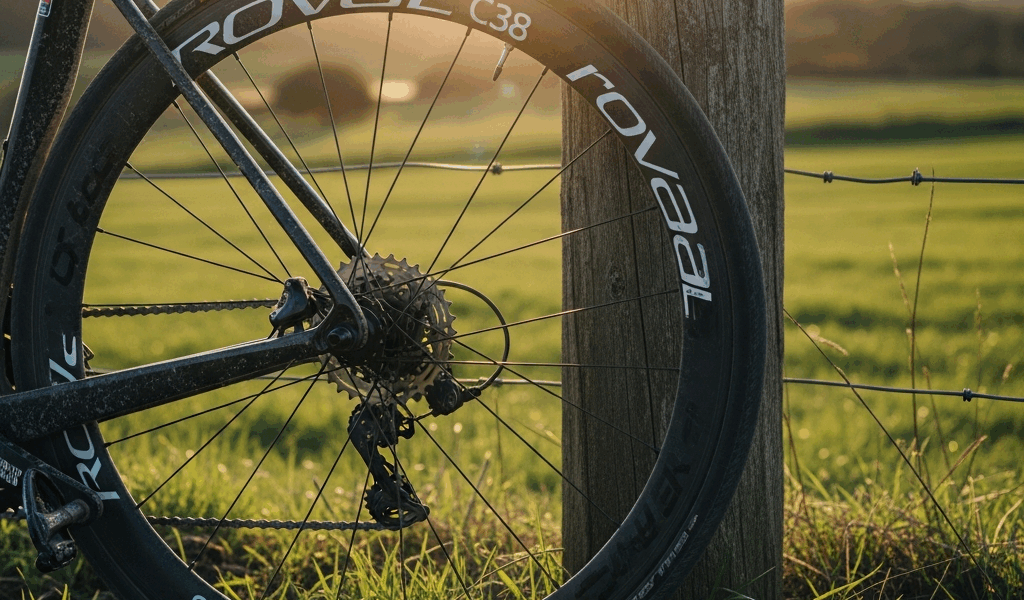
Roval C38 Carbon Wheelset — Is It Worth the Upgrade?
This article includes affiliate links. We may earn a commission at no extra cost to you.
Carbon wheelset research has evolved with all the spec-sheet noise flying around. As someone who spent three full weeks down a rabbit hole before finally pulling the trigger, I got hands-on with mid-depth carbon hoops — probably more than was healthy. I bought the C38s after my third season on aluminum, convinced I was leaving speed on the table every Tuesday ride. What I didn’t expect was how much they’d change the actual texture of long days in the saddle, not just the Strava numbers. Roughly 4,000 kilometers later — flat centuries, punchy gravel-adjacent roads up in Northern California, a few genuinely miserable wet rides — here’s what I actually think.
Roval C38 Specs and What You Get
Numbers first, because the spec sheet does tell part of the story.
- Rim depth: 38mm
- Rim width (external): 28mm
- Rim width (internal): 21mm
- Weight (wheelset): 1,490g for the disc brake version — front 640g, rear 850g
- Hub: DT Swiss 350-based with Roval’s Spoke Torque Control system
- Spoke count: 21 front, 24 rear
- Recommended tire width: 25–32mm
- Retail price: $1,600 USD for the disc version
That 21mm internal width jumped out the moment I pulled them from the box. My old wheels ran a 17mm internal — a narrower channel that, honestly, I’d never thought much about until I saw the difference in how a 28mm tire seats and rolls on the wider rim. The tire takes a rounder profile. That translates directly into compliance and cornering stability — more on that below.
But what is the competitive landscape here? In essence, it’s a crowded $1,200–$1,900 bracket. But it’s much more than that. The Zipp 303 Firecrest runs around $1,900 for disc. The Hunt 4454 Aero Disc lands at $1,200. Bontrager’s Aeolus Pro 37 sits at $1,450. The C38 is right in the middle — except the DT Swiss 350 hub internals give it a durability argument that house-brand hubs on some competitors simply can’t match. I replaced a freehub body on a cheaper wheelset at 2,500km. That was a $90 headache. Replacing DT 350 internals is a $30 fix you do on your kitchen counter, Saturday morning, coffee still hot.
Quick callout up front. The hub choice alone makes a compelling case at this price point, and most reviews gloss right over it.
Ride Quality — How They Feel on the Road
I mounted these on my Specialized Tarmac SL7 with 28mm Pirelli P Zero Race tires at 72 psi. First ride out — a Tuesday morning loop I’ve done maybe 200 times — the front wheel tracked in a slight crosswind on the first open stretch near the reservoir. The 38mm depth sits in a real sweet spot. You feel the wind. It’s not threatening, just present. I borrowed a friend’s 50mm hoops for a week last spring, and by comparison the C38s felt planted and predictable. There’s an exposed ridge road on my regular route that punishes anything over 40mm depth — the C38s went through it without drama.
Acceleration is where carbon clinchers earn their reputation. Hard. The C38s spin up noticeably faster than my old Mavic Aksium Race wheels — 1,870g as a set versus 1,490g is a 380-gram swing that you feel most in the first few pedal strokes out of a corner or off a stoplight. Sprint efforts felt snappier. Not dramatically so. But consistently enough that I stopped attributing it to good legs after the fifth or sixth ride.
Rough Road Behavior
There’s a frontage road I use for intervals — chipseal heavy, the kind of surface that has eaten through bar tape and rattled bottles loose mid-ride. Running a 28mm tire at 65 psi instead of the 80 psi I’d have trusted on a narrow rim, the C38s absorbed the buzz well enough that I held aero position longer without my hands going numb. That’s not marketing language about “compliance.” It’s the mechanical reality of a wider rim profile paired with a correctly inflated tire — those two things together do actual work.
Second month in, I hit a sharp square-edge pothole at about 35 kph on a descent. Heart rate spiked. The rim survived without a mark, the tire didn’t burp air. Skip past the mistake I made of assuming carbon automatically means fragile — and also don’t take descents you don’t know well at full commitment speed. Learned both lessons simultaneously.
Crosswind Handling
The 38mm depth keeps the C38 genuinely manageable in crosswinds up to around 25 kph. Above that, you’re making corrections — nothing sketchy, but you feel it. Riders who regularly deal with exposed coastal roads or high-desert conditions should know that 38mm is not a magic number that eliminates aerodynamic influence. It just keeps things predictable, which is actually what most of us need.
Braking Performance
I’m reviewing the disc brake version exclusively. Haven’t ridden the rim brake C38 — not going to speculate about it.
Standard 6-bolt rotor interface, 160mm front and rear by default. Pad compatibility is broad. I’ve run Shimano L04C metal pads and SwissStop Disc 29 organic pads with equal success — no glazing, no squeal after a 40km bed-in. Wet braking is where disc shines on a carbon rim, and the C38 benefits from that entirely. No carbon braking surface to worry about, no fade on long descents, no heat buildup concerns.
Wet Condition Performance
Late October, 90km route, unexpected rainstorm — no good shelter options within reasonable distance. I rode the last 25km in steady rain on unfamiliar descents with rotors I hadn’t recently serviced. Braking feel stayed progressive and consistent the entire time. No drama at all. The one variable worth flagging: rotor contamination from chain lube spray near a bike stand will mess with your feel fast — keep them clean and performance follows.
One honest note: I initially ran 160mm rotors front and rear and found the rear felt slightly grabby in technical spots. Switching to a 140mm rear rotor — apparently a common setup on endurance bikes — balanced things considerably. That’s not a C38 issue specifically, but if you’re setting up a disc wheelset for the first time, it’s worth knowing before you spend an hour diagnosing something that isn’t actually wrong.
Who Should Buy the Roval C38
Four thousand kilometers gives you a pretty clear answer. Here it is.
Buy the C38 If You Are
- An endurance rider who wants aerodynamic benefit without the handling anxiety that comes with deep-section wheels
- Someone riding mixed surfaces who needs a rim wide enough to support 28–32mm tires properly
- A rider who values long-term hub serviceability over chasing the lowest possible weight number
- Upgrading from aluminum and want one wheelset that works across most conditions without compromise
Skip the C38 If You Are
- A dedicated climber — at 1,490g, the Roval Alpinist CLX at 1,175g or the Hunt 3450 Gravel Carbon at 1,340g make more sense when vertical meters are the priority
- Budget-constrained — $1,600 is real money, and the Hunt 4454 Aero at $1,200 closes a lot of the performance gap for four hundred dollars less
- Expecting wind-tunnel gains to show up on every ride — on rolling terrain with variable pacing, aero wheels return less than steady-state testing suggests
That’s what makes the C38 endearing to us all-condition riders — it’s a wheelset built for people who ride a lot of different roads and want one answer that’s rarely wrong. It doesn’t lead any single category. Not the lightest, not the deepest, not the cheapest. The DT Swiss 350 hub, the wide 21mm internal channel, the manageable 38mm depth in crosswinds — those are deliberate, mature engineering decisions that show up every single ride, not just on optimal days. For most road cyclists clocking 5,000 to 10,000km a year on mixed terrain, that’s exactly what you need.



Stay in the loop
Get the latest cycle train central updates delivered to your inbox.