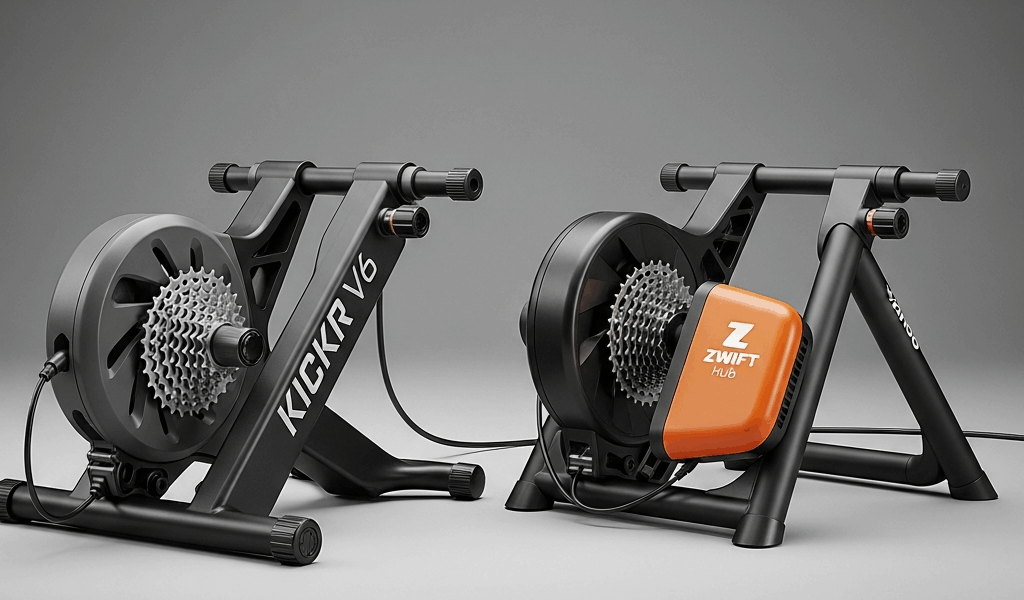
Wahoo KICKR V6 vs Zwift Hub — Which Smart Trainer Is Worth It?
The Wahoo KICKR V6 vs Zwift Hub decision is one I’ve watched cyclists agonize over more than almost any other gear purchase in the indoor cycling space right now. And honestly, I get it. When the Zwift Hub dropped at $499 USD, it broke something loose in the smart trainer market. Suddenly, the sub-$500 tier wasn’t just budget compromises and wobbly flywheels. It was a legitimate product from a company that runs the dominant indoor cycling platform. That changes the math significantly — but it doesn’t automatically make it the right choice for everyone.
I’ve spent time on both machines. The KICKR V6 (officially the Wahoo KICKR Bike Smart Trainer, 2022 generation, retailing around $1,199 USD) and the Zwift Hub (since updated to the Zwift Hub One, though the original Hub is still widely available around $499–$549) represent genuinely different philosophies about what a smart trainer should be. One is a premium, platform-agnostic workhorse. The other is a brilliantly priced ecosystem play. Let me walk you through the real differences so you can stop second-guessing yourself.
Price vs Performance at a Glance
Before anything else, here’s a side-by-side so you’re not hunting for numbers mid-article.
| Feature | Wahoo KICKR V6 | Zwift Hub |
|---|---|---|
| Price (USD) | ~$1,199 | ~$499 |
| Power Accuracy | ±1% | ±2.5% |
| Max Gradient Simulation | 20% | 16% |
| Flywheel Weight | 16 lbs (7.3 kg) | ~6.7 lbs (3 kg) |
| Noise Level (approx.) | ~60–62 dB | ~64–67 dB |
| Connectivity | ANT+, ANT+ FE-C, Bluetooth (x2) | ANT+, ANT+ FE-C, Bluetooth (x1) |
| App Compatibility | All major platforms | All major platforms |
| Auto Calibration | Yes (SpinDown + automatic) | Manual SpinDown |
The $700 price gap is the headline. It’s real, it’s significant, and it absolutely matters — especially if you’re not a professional racer or someone who bills indoor training as a business expense. But price alone doesn’t tell the full story here. The performance gap between these two trainers is real in some areas and basically irrelevant in others, depending on how you actually ride.
Ride Feel and Accuracy
Motivated by wanting to understand what that $700 premium actually bought, I paid close attention to the first 20 minutes on the KICKR V6 versus the first 20 minutes on the Hub. The difference in flywheel feel is immediate and not subtle. The KICKR’s 16-pound flywheel creates momentum that mimics outdoor inertia in a way the Hub’s lighter flywheel simply doesn’t match. Sprint efforts on the KICKR feel like accelerating into something. On the Hub, hard accelerations feel slightly more abrupt — the resistance responds quickly, but the coasting sensation is thinner.
That said — and this matters — most riders doing zone 2 base work, structured intervals, or group rides on Zwift will not find this difference ride-ending. It’s noticeable. It’s not catastrophic.
Power Accuracy — ±1% vs ±2.5%
Wahoo claims ±1% power accuracy on the KICKR V6. Zwift claims ±2.5% on the Hub. In real-world testing from sources like DC Rainmaker and GPLama, the Hub actually performs better than its spec suggests — often landing closer to ±2% in consistent conditions. The KICKR V6 holds its spec reliably, and when you factor in automatic calibration (the KICKR adjusts itself based on temperature and spindown data without you manually initiating anything), the consistency edge goes clearly to Wahoo.
Does ±1% vs ±2.5% matter to you? If you’re training with a power meter on your outdoor bike and you want your indoor numbers to match for TSS tracking and periodization — yes. It matters. If you’re riding Zwift for fitness and racing in the occasional community event — no. A 2.5% variance isn’t going to ruin your season.
One honest mistake I made early on: I assumed the Hub’s power readings would drift significantly over long rides without recalibration. After a proper warm-up (15 minutes is the standard recommendation before any spindown), the drift was minimal. Skip the warm-up and you’ll see inconsistencies. That’s not a flaw — that’s just physics. The KICKR handles this more automatically, which is a genuine quality-of-life win.
Gradient Simulation — 20% vs 16%
The KICKR V6 simulates gradients up to 20%. The Hub tops out at 16%. On most Zwift routes — including the longer climbs on Alpe du Zwift — you won’t exceed 12-13%. The Watopia KOM segments occasionally hit 14-15%. Practically speaking, 16% covers the vast majority of what you’ll encounter. The 20% ceiling matters more if you’re training specifically for mountain climbs like Ventoux or are running simulation software with custom extreme terrain.
App Ecosystem Lock-In
Probably should have opened with this section, honestly — because for a lot of people, the ecosystem question is the actual deciding factor, not the hardware specs.
Here’s the situation. The Zwift Hub is made by Zwift. It works natively and seamlessly with Zwift, and Zwift has done smart things to make the Hub experience polished — including direct pairing that sometimes feels faster than pairing third-party trainers. But — and this deserves emphasis — the Hub also works with TrainerRoad, Sufferfest (now Wahoo SYSTM), Rouvy, Kinomap, and every other ANT+/Bluetooth-compatible training platform. It is not technically locked to Zwift.
In practice, though, the product is clearly designed with Zwift as the primary use case. The marketing is Zwift-forward. The support documentation is Zwift-forward. If Zwift’s subscription price goes up (it’s already increased once, moving to $19.99/month), or if Zwift makes platform decisions you disagree with, you’re holding hardware built to serve that ecosystem.
What KICKR V6 Offers on Connectivity
The KICKR V6 supports dual Bluetooth connections simultaneously — meaning you can have Zwift running on your iPad and a heart rate app running on your phone without manually disconnecting and reconnecting. The Hub supports one Bluetooth connection at a time. This is a small thing until the moment it isn’t. Running Zwift on one device while logging to TrainingPeaks or Garmin Connect on another is a common setup for serious trainers. With the Hub, you’re choosing ANT+ for one of those connections, which requires a USB ANT+ dongle on most computers.
The KICKR also has a longer track record with Wahoo’s SYSTM training platform (formerly The Sufferfest), and Wahoo’s ecosystem — including the TICKR heart rate monitors and ELEMNT head units — integrates tightly. If you’re already in the Wahoo hardware world, the KICKR V6 fits cleanly.
Neither trainer has meaningful lock-in risk in terms of basic functionality. But the KICKR V6 is genuinely more flexible, and that flexibility costs you nothing extra once you’ve paid the purchase price.
Noise and Apartment-Friendliness
This section matters more than most reviews acknowledge. A lot of indoor cyclists live in apartments, condos, or homes with shared walls, light floors, or sleeping partners who aren’t thrilled about 5:45 AM interval sessions.
The KICKR V6 runs at approximately 60–62 decibels during moderate effort. Direct-drive trainers are quieter than wheel-on trainers as a category, and the KICKR V6 represents the quieter end of the direct-drive spectrum. The magnetic resistance system and the precision of the internal drivetrain components contribute to this. Wahoo has improved the bearing and gear tolerances in the V6 compared to the V5, and reviewers have consistently noted the difference.
The Zwift Hub runs a bit louder — approximately 64–67 dB in most independent tests. That 4–5 dB difference sounds small on paper. In practice, decibels operate on a logarithmic scale, meaning the Hub is roughly 1.5–2x as loud to the human ear as the KICKR V6 at similar wattages. Both trainers are noticeably quieter than a wheel-on setup or an older direct-drive unit from five or six years ago. But if you’re training at 6:00 AM in a studio apartment, that gap matters.
The other noise variable — and both trainers share this problem — is floor vibration. Neither unit eliminates the structural noise that travels through floors into downstairs units. A trainer mat (the Wahoo KICKR Mat, around $79, or a cheaper 6mm rubber gym mat) is mandatory if you have downstairs neighbors and a sense of decency. Vibration dampening riser blocks like the Feedback Sports Omnium Trainer Mat or generic anti-vibration pads can reduce low-frequency transmission further.
Verdict on noise — the KICKR V6 is measurably and noticeably quieter. For apartment dwellers, this alone might justify a portion of the price premium.
The Verdict — Who Should Buy Which
I’ve seen people tie themselves in knots over this decision. Let me make it simple.
Buy the Zwift Hub If —
- You are primarily or exclusively a Zwift rider and plan to stay that way
- Your budget is firm at under $600 and you won’t stretch it
- You’re new to smart trainers and aren’t sure how much you’ll actually use it
- Power accuracy at the 2.5% level is sufficient for your training goals
- You’re comfortable with one Bluetooth device at a time
The Zwift Hub at $499 is one of the best value propositions in indoor cycling hardware right now. Full stop. For the rider who wants to ride Zwift consistently, do group rides, maybe participate in some events, and build fitness through the winter — it does all of that without compromise. The slightly louder noise floor and lighter flywheel feel are real, but they don’t prevent a good training session. Frustrated by the premium pricing that dominated this category for years, the Hub is the trainer I’d recommend to a friend who trains casually to seriously but isn’t paying for a Wahoo SYSTM subscription or chasing race-caliber power accuracy.
Buy the Wahoo KICKR V6 If —
- You train on multiple platforms — Zwift, TrainerRoad, SYSTM, Rouvy, or others
- Power accuracy matters for periodization, TSS matching, or race preparation
- You live in an apartment and need the quietest direct-drive option available
- You want dual Bluetooth connectivity without managing ANT+ dongles
- You’re investing in a 5–7 year piece of equipment and want the build quality to last
- You’re training for events that include extreme gradients and want the full 20% simulation ceiling
The KICKR V6 is not cheap. At $1,199, it’s a real purchase decision. But the build quality, the whisper-quiet operation, the automatic calibration, the dual Bluetooth stack, and the platform flexibility are genuinely worth paying for if you’re a serious rider who plans to use this thing hard for years. I look at it this way — if you’re training 8–10 hours a week indoors, amortize that $700 premium over three years of training. That’s roughly $4.50 per week for noticeably better ride feel, better accuracy, quieter operation, and zero platform anxiety.
The worst outcome here isn’t buying either of these trainers. Both are good products. The worst outcome is buying the wrong one for your use case and resenting it six months later. Committed Zwift-only rider on a budget? Hub. Multi-platform serious trainer who’ll use this machine for half a decade? KICKR V6. The market finally gave us two clearly distinct, clearly capable choices at different price points — that’s a win for everyone buying a smart trainer in 2024.



Stay in the loop
Get the latest cycle train central updates delivered to your inbox.