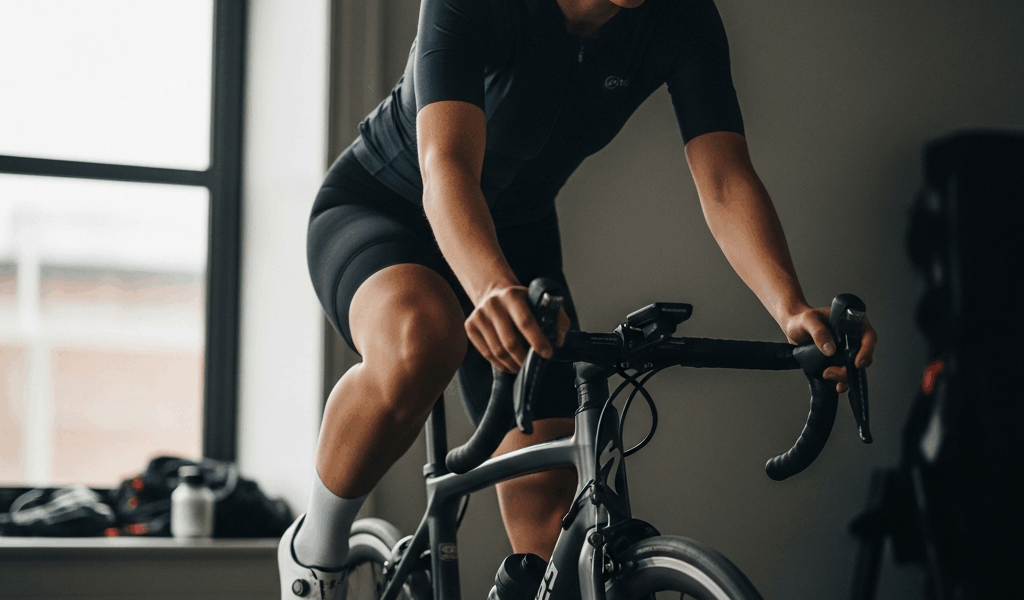
Single Leg Drills on the Bike — Do They Actually Improve Your Pedal Stroke?
Single leg drills cycling — you’ve heard about them, your coach probably assigned them, and you’ve almost certainly done at least one session clipped in with one leg dangling awkwardly off the side of a stationary trainer wondering if this is actually doing anything. I’ve been there. Spent three winters grinding through one-legged intervals on a Tacx Flux S thinking I was fixing my dead spot, only to get a power analysis back from a bike fit that showed almost no change in left-right symmetry. That experience sent me deep into the actual research, and what I found complicated the standard coaching narrative considerably.
What Single Leg Drills Are Supposed to Do
The theory is clean, at least on paper. When you pedal with both legs, the stronger leg can compensate for the weaker one. Your right quad fires hard through the power phase, and whatever your left leg fails to contribute gets covered up. The dead spot — that 12 o’clock to 3 o’clock zone where you’re transitioning from the pull to the push — goes unnoticed because the other leg is already driving through its power phase and keeping momentum going.
Single leg drills strip that compensation away. You isolate one leg, and suddenly every inefficiency shows up. The clunking at the top of the stroke. The inability to pull through the bottom. The leg that pushes down but never actively pulls back. Coaches have used these drills for decades specifically to make riders feel what a smooth, circular pedal stroke is supposed to feel like.
The recruitment argument is equally tidy. By forcing one leg to do the full work — push, pull, lift — you’re supposedly teaching your neuromuscular system to recruit the hamstrings and hip flexors through the recovery phase rather than letting them coast. The idea is that this pattern then transfers back to two-legged pedaling.
That’s the theory. It’s been standard coaching advice since at least the early Carmichael Training Systems era in the early 2000s, and it’s repeated confidently in most beginner cycling programs. The question is whether the evidence supports it.
What the Research Actually Shows
Here’s where things get interesting, and honestly a little uncomfortable if you’ve been assigning these drills to athletes for years.
A study published in the Journal of Applied Biomechanics by Korff et al. (2007) looked directly at whether instructing cyclists to pedal in circles — the explicit goal of most single leg work — actually changed muscle activity patterns. The finding was striking. When riders tried to pedal in smooth circles, their measured efficiency actually decreased compared to just pedaling naturally. The “natural” pattern of pushing down hard and mostly ignoring the recovery phase turned out to be mechanically efficient at most cadences, not a flaw to be corrected.
Follow that with work from Coyle et al. and subsequent research into gross efficiency in elite cyclists, and a picture emerges. Elite riders don’t have dramatically more circular pedal strokes than good amateur riders. What they have is higher neuromuscular power output and better metabolic efficiency — not a magic pull-through at 6 o’clock.
Neptune and Herzog (1999) modeled individual muscle contributions across the entire pedal cycle and found that the hamstrings and hip flexors do contribute during the recovery phase in trained cyclists, but their primary function is decelerating the extending limb to prepare for the next power phase — not actively pulling the pedal up the way the circular-stroke theory implies.
What single leg drills do demonstrably show is asymmetry. A 2014 study in the International Journal of Sports Physiology and Performance confirmed that single-leg power tests reliably identify limb-to-limb differences. If your left leg produces 15% less power than your right in a single-leg test, that asymmetry is real and worth addressing. The drill functions well as a diagnostic.
Where the evidence gets thin is on the transfer claim — that practicing single leg pedaling teaches your nervous system to recruit differently during two-legged pedaling. The motor learning literature does not strongly support this kind of inter-task transfer for a skill as habituated as cycling in experienced riders. The two tasks use different coordination strategies. Training one doesn’t reliably reshape the other.
When Single Leg Drills Help — and When They Waste Time
Probably should have opened with this section, honestly, because this is the practical answer most people are searching for.
They genuinely help beginners
If you’ve been riding for less than two years and haven’t yet developed ingrained pedaling patterns, single leg drills serve a legitimate purpose. The proprioceptive feedback — feeling the dead spot, noticing where your leg drops out of the stroke, experiencing the difference between a smooth revolution and a choppy one — is genuinely useful when those patterns are still being formed. A 10-minute block at low watts on a stationary trainer, something like 150–180 watts total target, broken into 30-second intervals per leg, gives a new rider real kinesthetic data.
New riders also frequently have significant strength or coordination asymmetries that stem from sports history or injury rather than cycling habit. Isolated by a single-leg protocol, these asymmetries surface quickly. One athlete I worked with found through single-leg testing that her right leg produced nearly 23% more power than her left — a gap that pointed straight back to an old ACL repair on the left knee that hadn’t been properly rehabilitated for cycling-specific strength.
They are largely wasted on experienced riders
Once you’ve logged two or three thousand hours on the bike, your pedaling pattern is deeply ingrained. The neuromuscular coordination is automatic. Single leg drills at this point don’t meaningfully alter that pattern. Research on motor learning in expert performers consistently shows that habituated movement patterns resist change from isolated practice of component skills — especially when those components are divorced from the actual two-legged context.
Experienced riders doing single leg drills on a trainer are also fighting against the physics of the situation. The trainer flywheel carries momentum through the dead spot for you, which reduces the very feedback the drill is supposed to provide. An elite cyclist doing single-leg work on a Wahoo KICKR at 90 rpm is getting a very different stimulus than coaches assume.
They work as a test, not a training tool
Use a single-leg test to identify asymmetry. A standard protocol — five minutes of easy warm-up, then three two-minute efforts at a self-selected cadence, left leg and right leg alternating with rest — will give you reliable relative power data. If the gap is under 5–6%, it’s within normal variation and not worth chasing. If it’s above 10%, you have an actual weakness to address, probably off the bike through targeted strength work.
Better Drills for Pedal Efficiency
If single leg drills aren’t the answer for most experienced riders, what is? The research and practical coaching experience point toward a few alternatives that show better transfer to real pedaling mechanics.
High cadence spinning
Forced high cadence work — sustained efforts at 100–110 rpm at low resistance — builds the neuromuscular smoothness that coaches are actually trying to develop with single leg drills. At these cadences, any jerky application of force becomes immediately obvious and self-correcting. You bounce in the saddle, you feel the roughness, and you adapt. This is the actual skill transfer mechanism, and it happens in the two-legged context where the pattern actually matters.
A practical protocol: four sets of five minutes at 105 rpm with two minutes recovery between them, resistance set to keep watts at about 55–65% of FTP. Do this once a week for six weeks and most riders report meaningfully smoother pedaling and improved comfort at race cadences.
Low cadence force work
Seated low-cadence intervals — 50–60 rpm at high resistance, sometimes called “strength endurance” work — develop the ability to apply force cleanly through the full power phase. This directly addresses one of the real problems in inefficient pedaling, which isn’t the recovery phase but rather the poor force application through the 2–5 o’clock sector where most power should be produced.
These efforts are hard. Three sets of eight minutes at 60 rpm and 85–90% of FTP will leave your legs genuinely fatigued in a different way than conventional intervals. That’s the point. You’re building the muscular capacity to apply pedal force with control under load.
Standing starts and accelerations
Short maximal accelerations from a near-stop — 8 to 10 seconds, out of the saddle, full effort — develop power application at low cadence and build the hip extension strength that contributes to efficient pedaling across the whole stroke. These are common in track cycling training and chronically underused in road and gravel training.
Six to eight standing starts at the end of a ride, recovering fully between each one, takes under 15 minutes and develops a neuromuscular quality that single leg drills simply don’t touch.
Targeted strength training off the bike
If you identify a genuine asymmetry through single-leg testing, the intervention that actually works is almost always off-bike unilateral strength work. Bulgarian split squats, single-leg Romanian deadlifts, step-ups with a 16-inch box — these address the underlying strength deficit rather than trying to retrain a motor pattern through isolated cycling movements.
Frustrated by persistent left-right imbalance despite years of single-leg drill work, a lot of riders I’ve spoken with finally closed the gap within one training block after adding two strength sessions a week with unilateral lower body emphasis. The gap doesn’t close through more drills. It closes through building the actual strength that the weaker leg is missing.
The Bottom Line
Single leg drills are not useless. As a diagnostic tool, they’re genuinely valuable — probably the fastest way to surface a meaningful asymmetry in leg power. As a teaching tool for new riders still building their movement patterns, they provide useful proprioceptive feedback during a window when patterns are still being established.
For experienced riders, though, the evidence doesn’t support using them as a primary pedaling efficiency intervention. The motor learning transfer is weak, the feedback mechanisms are compromised by trainer inertia, and there are better drills available that operate in the actual two-legged context where efficiency gains matter. High cadence work, low-cadence force intervals, and real strength training for identified weaknesses all have stronger mechanistic and empirical support.
Use single leg drills to find the problem. Use everything else to fix it.



Stay in the loop
Get the latest cycle train central updates delivered to your inbox.