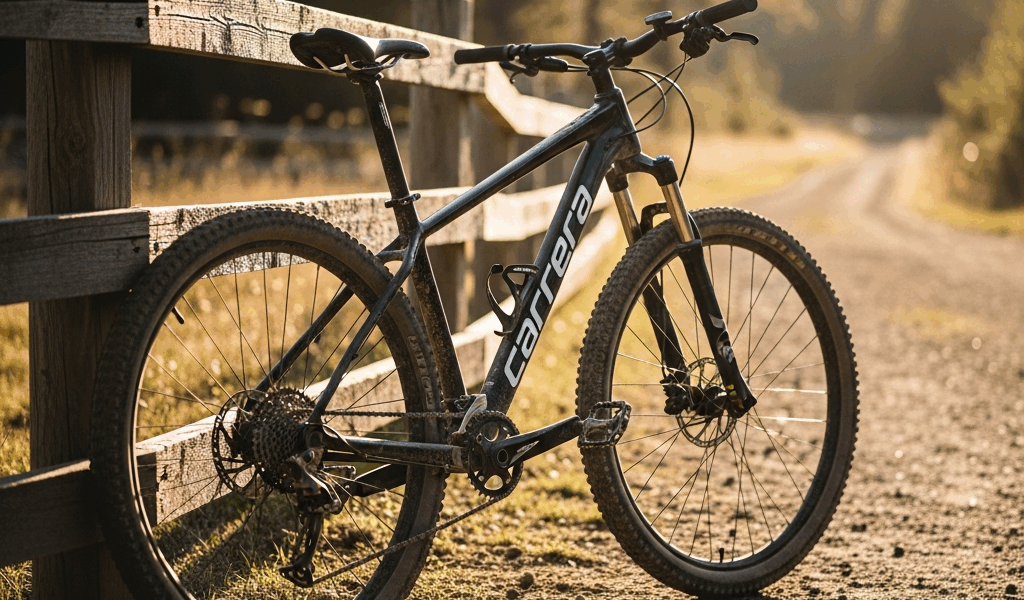
The Verdict Up Front
Buying a hybrid bike has evolved with all the spec-sheet noise flying around. As someone who spent just over a year riding the Carrera Crossfire 2 through city commutes, canal paths, and weekend loops, I spent months getting comfortable with this particular machine. Today, I will share it all with you.
Short version: the Crossfire 2 is worth your money if you’re a casual commuter or weekend rider watching the budget. It is not worth your money if you log serious miles or expect the bike to feel effortless going uphill.
But what is the Crossfire 2, really? In essence, it’s a mid-tier entry in Halfords’ Carrera hybrid range — sitting between the cheaper Crossfire 1 and the better-equipped Crossfire 3. But it’s much more than that. It’s a bike that rewards the right kind of rider and quietly punishes the wrong one. The whole experience hinges on three things: the Shimano Tourney/Altus groupset, the 700c wheels, and the aluminium frame. None of them are exceptional. They are, however, functional — and that distinction matters enormously depending on what you actually need.
Flat terrain, under 20 miles a week, nothing too demanding? Buy it. Planning regular hill climbs or using the bike as genuine daily transport? Save the extra £50–£80 and get the Crossfire 3. I’m not hedging. That’s the answer.
What the Ride Actually Feels Like
I’ve put in just over a year on this bike. The first week I was genuinely disappointed with the groupset. By month two I’d recalibrated my expectations. After that, it started making sense.
The flat handlebar geometry is probably the Crossfire 2’s best quality. You sit upright — shoulders relaxed, back comfortable, eyes on the road ahead. Coming off a drop-bar road bike or dragging something out of a dusty garage after five years, this position feels immediately stable. Traffic lights don’t feel like a balancing act. That’s what makes this geometry endearing to us nervous urban cyclists, honestly.
The Tourney groupset handles flat-to-moderate roads without drama. Shifts are responsive enough on smooth tarmac. The problems show up on sustained climbs — the low end gives you a 28-tooth cassette paired with a 28-tooth chainring, which is workable on gradients around 5–8%. Push beyond that and you’re grinding. I learned this on a canal towpath that turned out to be steeper than it looked on the map. Not catastrophic. Just slow, grinding, and humbling in a way I hadn’t anticipated.
The tyres are 38mm — wide enough for light off-road use, narrow enough to roll decently on tarmac. Broken pavement doesn’t jar your wrists. Smooth cycle paths feel quick. Rain grip is adequate for UK conditions, though I’d strongly recommend swapping to all-season rubber before November. Don’t do what I did — I left the stock tyres on through a wet October and regretted it almost immediately.
Weight comes in around 13.5kg depending on the variant. Manageable on a train. Noticeable the moment you lift it overhead onto a car rack. The aluminium frame is rigid without being punishing — Carrera has apparently found a calibration that works for this price point, because the ride quality is better than you’d expect for the money.
Components Worth Knowing Before You Buy
Quick callout up front.
The spec sheet Halfords publishes is accurate but incomplete. They list the groupset name without flagging that the derailleur is Tourney rather than Altus — and that distinction matters, because adjustment drift becomes a real issue around month four or five. Plan for it. Budget for a basic service or learn to adjust the barrel tensioner yourself. It’s not difficult, but it is a recurring task.
Brakes vary by variant. Some Crossfire 2 models ship with mechanical disc brakes. Others come with V-brakes. Check the specific listing before you buy. Discs handle wet weather better and offer more consistent stopping power. V-brakes are lighter and easier to maintain. For commuting in rain, discs win — no contest. For 10 miles on dry Saturday pavement, V-brakes are perfectly fine.
The saddle is the first thing I’d replace — at least if you plan to ride for more than 30 minutes at a stretch. Carrera’s stock saddle is firm and narrow, seemingly designed for someone who hasn’t been on a bike since school and isn’t planning to push that record anytime soon. I’m apparently someone with fairly average sit bone width, and a Selle Royal Explora at around £28 transformed the experience while the stock saddle never stopped being uncomfortable. A comparable Velo saddle runs £20–£30 and works just as well. Either way, budget for it immediately.
The shifters are Shimano indexed — reliable, intuitive, unfussy. Gear changes aren’t crisp the way a Deore or Alivio setup would be, but they’re clean and beginner-friendly. No complaints there.
One more thing: the Crossfire 2 arrives partially assembled. Build quality depends entirely on whichever mechanic finished the job at your local Halfords. I’ve seen two examples in person — one was immaculate, the other had the seatpost set at a visible angle that needed correction before the bike was safe to ride. Check everything before you leave the store. Seatpost alignment, brake cable tension, wheel true. Make them fix anything obvious while you’re standing there.
Crossfire 2 vs Crossfire 3 — Which One to Get
The Crossfire 3 costs £50–£80 more. So, without further ado, let’s dive into what that money actually buys you.
You get Altus shifters instead of Tourney — the lever action is heavier and more deliberate, indexing holds longer, and adjustment drift is less of an ongoing concern. Many Crossfire 3 variants also ship with hydraulic disc brakes, which offer noticeably better modulation and wet-weather stopping compared to mechanical discs. Frame finish is sometimes marginally better, though that’s aesthetic and barely worth factoring in.
The decision is straightforward. Commuting five days a week, or expecting to cover more than 50 miles in a typical week? Buy the Crossfire 3. The cost per mile difference is negligible. If you’re a weekend rider doing 10–15 miles on Saturday mornings, the Crossfire 2 is not a compromise — it’s genuinely the right tool for that use case.
I bought the Crossfire 2 originally because I was keeping costs tight. Three months later I’d spent the difference on component upgrades anyway — a new saddle, all-season tyres, a rear rack, mudguards. Had I just bought the Crossfire 3, I’d have saved myself the frustration and come out roughly even financially. That’s the actual lesson here, and it applies to most people shopping this end of the hybrid market. Avoid the path I took.
First Upgrades Most Owners Make
If you already own a Crossfire 2 — or you’ve just bought one and found this article slightly too late — here are the three upgrades that genuinely matter:
- Saddle replacement — Budget £25–£35 for a Selle Royal Explora or a Velo equivalent. This single change makes the bike usable for anything over 30 minutes. The stock saddle is not.
- Mudguards — The Crossfire 2 has mudguard mounts built in. Halfords’ own brand guards run £20–£30 and fit directly without modification. Commuting in British weather without guards means wet trousers, a wet drivetrain, and a gradually deteriorating bottom bracket. Not acceptable for a bike you’re relying on.
- Rear rack — Carrera’s mounts support a standard rear rack. A basic steel or aluminium rack from Halfords costs £25–£40 and immediately converts the bike from recreational use to genuine commuter duty. Strap your bag to the rack instead of wearing a backpack and the handling improves noticeably — especially at low speeds in traffic.
These three upgrades total roughly £70–£100. The stock bike feels incomplete without them. That’s not a criticism so much as a reality of what a £350–£400 hybrid actually is — a platform that gets you most of the way there.
So: is the Carrera Crossfire 2 worth buying? Yes — if you’re going in clear-eyed about what it is. A capable, unfussy hybrid for casual riding. No — if you’re expecting budget-priced performance or planning to grow into it aggressively over time. Buy it for what it is. Not for what you’re hoping it might eventually become.



Stay in the loop
Get the latest cycle train central updates delivered to your inbox.