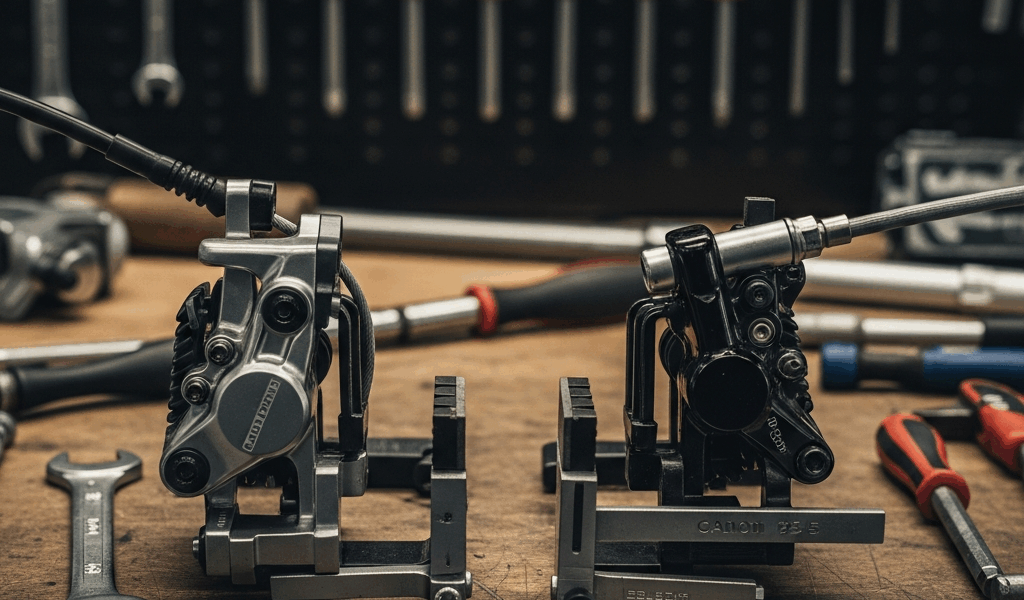
Mechanical vs Hydraulic Disc Brakes — Which Bike Brakes Are Better?
This article includes affiliate links. We may earn a commission at no extra cost to you.
Disc brake debates have become harder to navigate with all the conflicting opinions flying around — forums, YouTube comments, bike shop regulars who swear by whatever came stock on their first “real” mountain bike. Today, I’ll share it all with you. No fence-sitting. No “well, it depends on your needs” non-answer. Just what I’ve actually seen across hundreds of installations, from $400 hardtails to $6,000 carbon builds.
Mechanical vs Hydraulic Disc Brakes — Key Differences
But what is the actual divide between these two systems? In essence, it’s how force travels from your fingers to your brake pads. But it’s much more than that — the delivery method changes everything about feel, maintenance, and long-term reliability. Here’s the breakdown I put together based on the systems I touch most: Shimano’s MT200 hydraulic calipers, the Tektro HD-M290, and mechanical staples like Avid BB7 and Shimano BR-M375.
| Feature | Mechanical Disc Brakes | Hydraulic Disc Brakes |
|---|---|---|
| Stopping Power | Good | Excellent |
| Modulation | Moderate | Superior |
| Maintenance Ease | High (DIY-friendly) | Moderate (requires bleed kit) |
| Maintenance Frequency | Higher (cable stretch) | Lower (self-adjusting) |
| Weight | Slightly lighter system | Slightly heavier |
| Entry Cost | $30–$80 per brake | $60–$200+ per brake |
| Trailside Repair | Easy | Very difficult |
The weight gap is real — roughly 100 to 150 grams lighter for a full mechanical cable setup versus a comparable hydraulic system. Honestly? Most riders will never feel that difference. XC racers fighting for podium spots might. Everyone else is probably hauling a water bottle that weighs more.
Stopping Power and Modulation
Hydraulic brakes earn their reputation here. Modulation — your ability to apply graduated, precise braking force rather than a binary squeeze-or-nothing — is dramatically better on fluid systems. Mineral oil doesn’t stretch. It doesn’t fray. It doesn’t behave differently after sitting in a wet cable housing for three rainy months.
Frustrated by two years of wooden-feeling Tektro mechanicals, one of my regular customers finally let me put Shimano SLX M7100 hydraulics on his 29er trail bike last spring. First descent back. He rolled up to the shop grinning like I’d swapped the whole bike out. It wasn’t just stopping power — it was the feel. That’s modulation doing its job, and it’s hard to explain until you’ve experienced the difference firsthand.
Mechanical brakes in wet conditions are where things get genuinely inconsistent. Housing absorbs moisture. Steel cables corrode — slowly, then all at once. I’ve seen a fresh mechanical setup feel crisp in July and completely wooden by November after regular wet trail use. You can slow that degradation with stainless cables and sealed housing — Jagwire’s Sport series runs about $18 a set and is worth every dollar — but you’re buying time, not a solution.
Self-Adjusting Pads — The Feature Nobody Talks About Enough
Hydraulic pistons push outward incrementally as pads wear. Pad-to-rotor clearance stays consistent. Your lever feel at 90% pad life is nearly identical to day one. Mechanical brakes don’t work this way — as the pad wears down, the lever has to travel farther before anything contacts the rotor. You fix it by adjusting the pad adjuster screw or tightening the cable barrel. Simple enough. But you have to notice it’s happening first.
A lot of riders don’t notice. I’ve pulled mechanical setups off bikes where the cable tension had degraded so far the rider was pulling the lever nearly to the handlebar before meaningful braking occurred. That’s not a performance quirk. That’s a genuine safety issue, and it’s more common than it should be.
Maintenance — Which System Is Easier to Live With
Here’s the part worth saying first — because for most people buying bikes in the $500 to $1,200 range, maintenance reality matters more than peak braking performance on a technical descent they’ll never ride.
Mechanical brakes win on accessibility. Snapped cable? Fifteen minutes, a 5mm hex key, a cable cutter, and $8 worth of stainless cable from any shop. You can do this repair in a trailhead parking lot. No fluids, no special tools, no YouTube tutorial required. If you do bikepacking trips far from civilization — or just far from a shop that knows what it’s doing — that repairability is genuinely meaningful.
Hydraulic maintenance is a different animal. Bleeding — pushing fresh fluid through the system to purge air bubbles — is required roughly every one to two years depending on riding volume and conditions. While you won’t need a full workshop setup, you will need a handful of specific items: a brand-matched bleed kit, clean rags, gloves, and a genuinely clean surface to work on. Shimano and SRAM use different fluids — mineral oil versus DOT — and they are absolutely not interchangeable. Don’t make that mistake. The Shimano bleed kit runs about $25 and is legitimately user-friendly once you’ve done it two or three times. The first time is humbling.
I’m apparently not immune to that learning curve, and Shimano’s MT500 worked fine for me after I ruined my first attempt spectacularly. Introduced air somewhere in the system on an unsupervised bleed job, spent two hours diagnosing it, started over from scratch. That was an expensive afternoon. If you’re not mechanically confident, pay a shop $30 to $50 per brake for a professional bleed the first couple of times and watch closely.
Long-Term Cost Reality
Brake pads cost about the same either way — $10 to $20 a pair regardless of system. Cables and housing for a full mechanical setup run maybe $30 a year if you’re replacing them on a sensible schedule. Hydraulic systems cost more per service visit at a shop, but those visits are less frequent. Run the actual numbers over a three-year period and the cost difference is genuinely closer than most people expect.
Should You Upgrade from Mechanical to Hydraulic?
The upgrade conversation is where I see real money wasted. So, without further ado, let’s dive into the framework I actually use when customers ask me this question — because there are four things worth thinking through before spending anything.
- Bike value matters. If your bike is worth under $600, bolting on a $200 hydraulic upgrade is poor economics. That money belongs toward the next bike entirely.
- Your riding matters. Commuters and casual weekend trail riders see marginal real-world benefit from hydraulic brakes. Aggressive mountain bikers, enduro riders, anyone descending technical terrain regularly — the upgrade pays off in confidence and actual control.
- Compatibility matters more than people realize. Switching to hydraulic means new levers, new calipers, new hoses — and if your current levers are integrated with your shifters, which is common on road bikes, the complexity multiplies fast. Budget $150 to $350 minimum for the full switch.
- Your willingness to maintain them matters. Hydraulic brakes that never get bled will eventually feel worse than mechanical brakes getting regular cable swaps. The system rewards attentive owners.
Dragged into exactly this conversation last January, I found myself talking a customer down from putting Shimano XT M8100 hydraulics on a six-year-old hardtail worth maybe $500. Learn from what tripped me up of letting that conversation run too long before redirecting. We put Tektro HD-M290 hydraulics on instead — $65 a side, genuinely solid performer — and he left with money still in his pocket for new tires. That’s the smart upgrade path.
Here’s where I land after twelve years of working on both systems. Hydraulic disc brakes perform better. Better modulation, better wet-weather feel, lower ongoing fuss once the maintenance learning curve is behind you. Mechanical brakes aren’t bad — Avid BB7 might be the best option for riders who need field-repairable simplicity, as touring and remote riding requires exactly that kind of self-sufficiency. But mechanicals are the compromise option. If budget and trailside repairability top your priority list, that compromise is entirely defensible. If you want the best braking experience your hands will ever feel on a bike, hydraulic wins — and it’s not a particularly close debate.
Related: Compare this advice with our specification-based Carrera Crossfire 2 review and buying checklist.


Stay in the loop
Get the latest cycle train central updates delivered to your inbox.